
Why Movement Is One of the Most Powerful Tools for Children’s Wellbeing
It is halfway through the morning.
One child is swinging their legs under the table. Another is leaning back in their chair. Someone has asked to sharpen a pencil for the third time. A few children are trying hard to listen, but their bodies are telling a different story.
It can look like distraction.
But often, it is the body asking for movement.
For a long time, classrooms have asked children to sit still for long periods of time. Stillness is often treated as a sign of attention, cooperation or readiness to learn.
But children are naturally designed to move.
Long before they can explain how they feel with words, children communicate through their bodies. They run, climb, spin, stretch, bounce, curl, reach and explore the world through movement.
During the toddler years, we usually celebrate this curiosity. We expect young children to move. We understand that movement is part of how they learn.
Then, as children enter school, something shifts.
We dress them in uniforms, ask them to sit for longer stretches of the day, and often begin rewarding stillness over movement. Structure has its place, of course. But children’s bodies have not suddenly changed because they have reached school age.
Their need to move remains fundamental to their development, wellbeing and learning.
Children do not outgrow their need for movement.
They simply become better at suppressing it.
Movement is more than exercise
Modern childhood often includes longer periods of sitting, increased screen time and busy routines. Many children spend much of the day relatively still.
At the same time, parents and teachers are noticing rising levels of anxiety, emotional overwhelm and difficulties with concentration.
Movement is not a cure-all. But it is one of the most powerful and natural tools we have for supporting children’s wellbeing. This is where movement becomes more than exercise. It becomes part of how children learn to notice, regulate and return to themselves.
It is one of the foundations of healthy emotional development. When children move, far more is happening than muscles becoming stronger. Movement increases blood flow to the brain, supports mood, and activates areas involved in attention, memory and emotional regulation. Movement also gives the nervous system an opportunity to regulate.
Think about how naturally children move after a strong emotion. They might pace, jump, swing their legs, run outside, curl up, stretch or shake their hands.These are not always random behaviours. Often, they are the body’s way of processing emotional energy. So rather than seeing movement as a distraction from learning, we can begin to see it as preparation for learning.
What we mean by mindful movement
Mindful movement begins when children are invited to notice their bodies as they move. This is not about perfect yoga poses or getting every movement “right.”

This is not about perfect yoga poses or getting every movement “right.” In this sense, mindful movement is movement with awareness — gentle, intentional and connected to how the body feels.
A stretch, a balance, a slow flowing movement, or a steady standing shape can do more than move the muscles. It can help the body feel organised, grounded and ready.
Many of these practices are inspired by ancient traditions that have long understood the relationship between the body, breath and mind. In this sense, mindful movement is movement with awareness — gentle, intentional and connected to how the body feels.
For children, this might look like stretching tall like a tree, balancing on one foot, crossing the body’s midline, moving slowly like clouds, or breathing as the arms rise and fall.
A child might begin to notice:
“My shoulders feel tight.”
“My legs want to move.”
“My breath is fast.”
“I feel more settled now.”
“I feel ready to try again.”
These small moments of noticing matter.
They help children begin to understand the connection between body, feeling and behaviour.
What mindful movement can support
Mindful movement can help children develop:
body awareness
emotional awareness
self-regulation skills
resilience
focus and attention
confidence
When children begin recognising the physical signs of frustration, excitement, tiredness or anxiety, they are better equipped to respond before emotions become overwhelming.
A clenched fist might become a signal.
A fast breath might become something to notice.
A restless body might become something to support, not shame.
This is where movement becomes more than a break. It becomes a language.
A way for children to listen to themselves before they have all the words.
Movement supports learning too
Teachers are often under enormous pressure to maximise every minute of teaching time, even though we all know some moments of the school day have a way of disappearing anyway. So pausing for movement can feel counterintuitive.
But sometimes, one of the most effective ways to support learning is to pause for movement.
A short movement break can refresh attention, reduce restlessness and improve engagement.The CDC notes that classroom physical activity can support concentration, on-task behaviour, motivation and engagement, while reducing disruptive behaviour such as fidgeting [link].Even 30 seconds of purposeful movement between lessons can shift the energy in a room.
Yes, 30 seconds.
One breath in. A movement. One breath out. One small reset.
Movement is not time lost. It is an investment in learning.
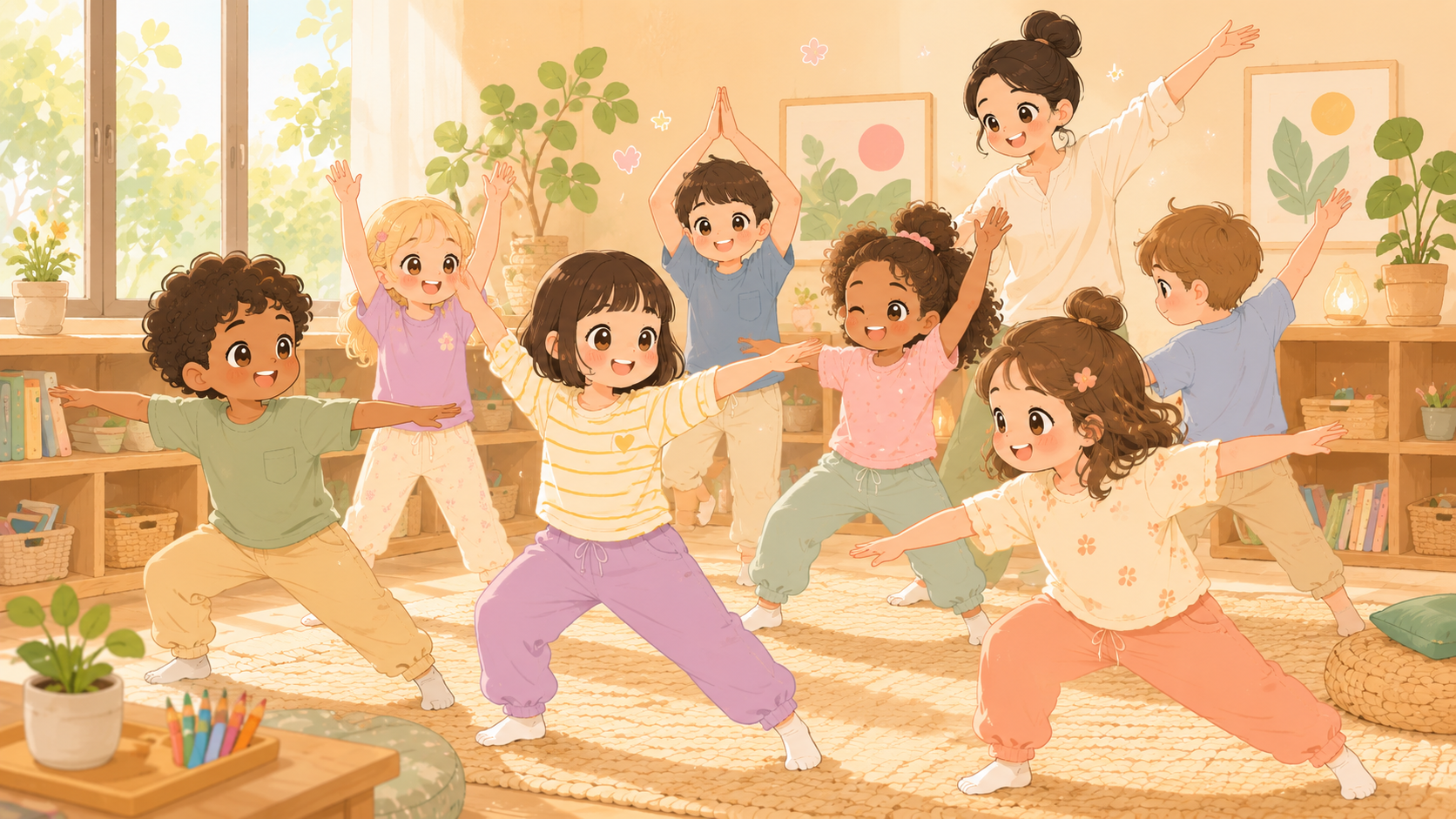
Small moments of movement can help children arrive, reset and return.
A small shift in the school day
Supporting children’s wellbeing does not always require expensive programmes or dramatic changes.
Small moments throughout the day can have a meaningful impact, especially when they are repeated consistently.
A class might stretch before writing.
Shake off playground energy after break.
Balance like trees before a transition.
Breathe with arms rising and falling.
Move slowly like clouds before listening.
Reach, curl, sway, or pause, before beginning again.
These moments can be woven into the rhythm of the school day - as a simple way to help children arrive, reset and return.
Weaving wellbeing into everyday school life
Wellbeing does not need to be squeezed into one lesson a week. Small moments of mindful movement can be woven through the rhythm of the day — one movement, one mindful moment and one small connection at a time.
Because when children move with awareness, they are not simply exercising. They are building the foundations for confidence, resilience, emotional regulation and lifelong wellbeing.
And when children begin to understand their bodies, they are better equipped to understand themselves.
For teachers looking for simple ways to bring this into the classroom, MindFresh Moments offers short movement-led wellbeing tools that can be woven into the school day.

A moment to pause, notice and return
Mindful Moment
Try this simple movement pause with children, or for yourself.
Stand or sit with both feet on the floor.
Take a slow breath in as you lift your shoulders gently towards your ears.
Breathe out and let the shoulders drop.
Repeat three times.
Then ask:
What changed in my body?
Do I feel the same, or slightly different?
Even a tiny shift is worth noticing.